
You were quoted a service upgrade by somebody who had not seen your panel. It is a calculation, and it might be a no.
A charger is a long, steady load, which is why it gets its own circuit and why the panel comes into it at all. Whether your service carries it is arithmetic on what the house actually runs, including whether you heat and cook with gas or electricity. A sixty amp service will not take a Level 2 charger. Whether a hundred will is a real question with a real answer, and the answer comes from looking at the panel first.
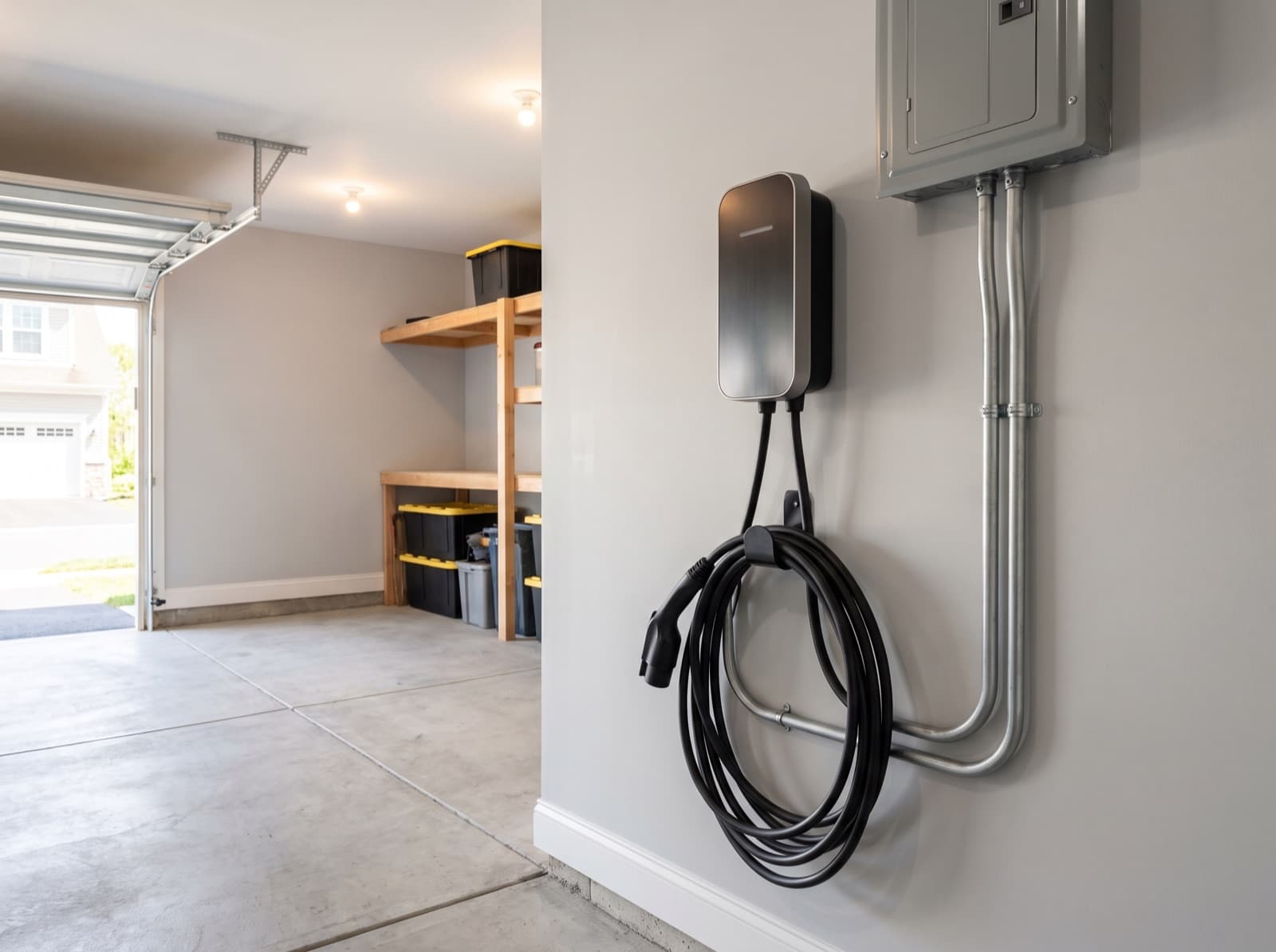
- A dedicated circuit to the garage or the driveway
- Free estimate, price agreed before work starts
- Licensed and insured, NJ #19320
Panel, permit, circuit, inspection.
The panel gets looked at before anything is promised
What the service is rated at, what is already on it, and what the house actually runs. That is what decides whether a charger needs a service upgrade in front of it.
The permit question gets answered honestly
New Jersey's own homeowner guide has a table for this, and not every charger job needs the same thing. Swapping a correctly sized existing outlet for plug compatibility is ordinary maintenance. A new circuit or a direct connection is permitted minor work with an inspection.
Plug in or hardwired, decided on purpose
A plug and receptacle charger has GFCI requirements a hardwired one does not, and the receptacle becomes the part working hardest during an eight hour charge. It is a real choice rather than a preference.
The price is agreed before the work
Estimates are free, and you know the number before the conduit goes up.
Before you buy the charger.
Real questions, taken off the forums and inspection sites where homeowners ask them, with a link to where each one was asked.
Do I need a panel upgrade to install an EV charger?
Sometimes, and the only way to know is to look. It usually means running a dedicated circuit to the garage or the driveway, and depending on the age of your panel it can mean a service upgrade first. Worth asking about before you buy the charger rather than after it arrives.
The original question on RedditWill a hundred amp service carry a Level 2 charger?
It might. The optional load calculation in the code applies to services rated one hundred amps or more, so a hundred amp house is a calculation rather than an automatic no, and the answer swings on whether the heat, the water and the range are gas or electric. A sixty amp service will not carry it, and that one is not a maybe.
The code text on UpCodesCan I just use the dryer outlet?
That is the most common version of this question and the answer is usually no, not as it stands. The older three pin dryer outlets have no separate ground, which is the whole problem, and the dryer circuit is also already spoken for. A charger wants its own circuit sized for a long continuous load.
The original question on RedditDo I need a permit for an EV charger in New Jersey?
The state publishes a homeowner guide with a table for exactly this. Replacing an existing, correctly sized outlet so the plug fits is ordinary maintenance, with no permit and no inspection. Upgrading the breaker and the wire to a higher rating needs a permit and an inspection. A charger that needs a new outlet or a direct connection also needs a permit and an inspection. Those last two are minor work, which means the work can start before the permit issues as long as the local enforcing agency is notified first and the application follows within five business days.
The NJ DCA guidance (PDF)Is there still a federal tax credit for a charger or a panel upgrade?
Not now, and this is worth being straight about because plenty of pages still say otherwise. The IRS states that the energy efficient home improvement credit is not allowed for property placed in service after 31 December 2025, and the charger credit is not allowed for property placed in service after 30 June 2026. Both were ended early by law in July 2025. New Jersey's federally funded home energy rebates, which would cover panel work, are described by the state's own clean energy program as still in development and not open for applications.
The IRS guidance